
Rich Pham is a dear friend of mine. He launched Pocari Sweat in Vietnam back in 2012, sits on a handful of boards of advisors, and somehow still finds time to race cars for fun. Somebody mentioned before he even started talking that he never forgets to call for a catch-up around 3 or 4 in the afternoon. That detail stuck with me more than it probably should have. It's very him. Busy in a way that would flatten most people, and still the one remembering to check in.
He was there to talk about monkeys. Not the animal. The metaphor.
A monkey, in this framing, is a task. Every time someone on your team walks in with a problem and says "what should I do about this," and you say "let me think about it and get back to you," the monkey just jumped off their back and onto yours. You didn't help them. You took their job.
Most managers do this constantly, apparently, and call it being supportive.
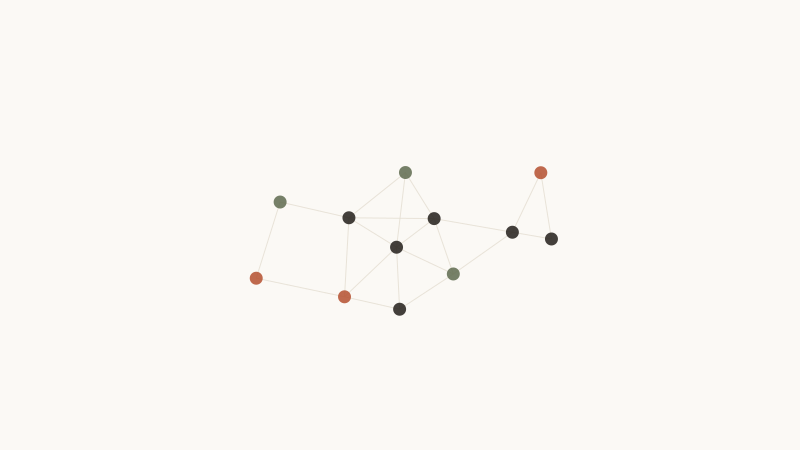
The fix isn't complicated to describe, just hard to actually do. Manager sits at the top, not because they control everything, but because they're directing toward success without becoming the roadblock everyone routes around. Empower the people who can actually think through their own solutions. Build something that runs whether you're in the room or not.
That's not laziness. That's the job.
Rich put it more bluntly than I would have. A manager should only do two things: bring in money, and work themselves out of a job. Everything else is either training somebody else to do it, or getting out of the way so they can.
There's a risk on the other side too, apparently. People hide their monkeys sometimes, scared to bring a problem forward, right up until the thing's grown too big to hide anymore. If that's happening on your team, you've probably given too much rope. Sounds backwards. Isn't.
A few other things I wrote down, roughly in the order they came at me.
Time is a pizza. Keep handing out slices to solve everyone else's small problems and there's none left for you to actually think about strategy. Obvious once someone says it out loud. I'd never put it that plainly to myself before.
There are four levels people operate at with a task. Wait to be told. Ask what to do. Recommend a solution and check in before running with it. Or just go handle it and report back after. Most people can move up that ladder faster than you'd assume, if you actually let them, instead of assuming they need the same level of hand-holding forever.
Checkpoints are pit stops, not surveillance. Set the interval, then let the car run in between. Checking in every five minutes isn't oversight, it's just you refusing to let go of the wheel.
Training is sharpening the axe before you cut the wood. Not a nice-to-have you get to once things calm down, because things never calm down, and an unsharpened axe just means every single cut takes longer than it should.

Somebody in the room asked how many direct reports is too many. Rich said the best book on the subject puts it at seven. Past that, you're not managing anymore. You're just reacting, one fire at a time, never actually ahead of anything.
He also said something I keep turning over since. You got promoted because somebody else screwed up. Not because you were the obvious next king. There's a version of that sentence that stings a little, and a version that's actually freeing, and I think it depends entirely on whether your ego needed the promotion to mean something bigger than it does.
Relax-king, he called it instead. Still in charge. Just not standing on everyone's desk.
I've been trying to notice, this past week, how many monkeys I've quietly picked up without meaning to. More than I expected. Old habit, I think, from years of being the one who fixes things because fixing things was faster than teaching someone else to. Faster today. Slower every day after, compounding, until you're the bottleneck in your own company and can't figure out why nothing moves without you.
Worth reading the original if you haven't. Oncken and Wass wrote the first version of this back in the seventies for Harvard Business Review, and it's aged better than almost anything else I've read out of a management textbook.